

Policy Brief | Delivering a Nature-Positive Europe: Insights from Biodiversity Nexus Modelling
Introduction
Europe faces the interconnected challenges of biodiversity loss, climate change, water stress, food-system pressures and declining ecosystem resilience. Addressing these challenges requires policies that move beyond sectoral approaches and recognise the interdependencies between biodiversity, food, water, energy, transport, climate and health. The BIONEXT project developed an innovative nexus modelling framework to explore how alternative pathways of societal transformation could deliver nature-positive and socially just futures across Europe by 2050.
The modelling framework was applied to three co-created pathways based on the IPBES Nature Futures Framework: Dòigh Nàdair: The way of nature (Nature as Culture), emphasising community stewardship and agroecology; NaturAll (Nature for Nature), prioritising ecological integrity and sufficiency; and Return to Nature (Nature for Society), focusing on innovation, circularity and nature-based solutions. Despite their different value perspectives, all three pathways improve biodiversity, reduce greenhouse gas emissions, lower resource use, strengthen water security and enhance health and wellbeing.
The results demonstrate that there is no single route to sustainability. Multiple pathways can achieve nature-positive outcomes when policies address common drivers of environmental degradation and are designed coherently across sectors. The findings provide practical insights for accelerating implementation of the European Green Deal, EU Biodiversity Strategy and broader sustainability objectives.
Evidence and Analysis
Multiple pathways can deliver nature-positive futures
The BIONEXT modelling shows that Europe can achieve substantial progress towards sustainability through different, but equally plausible, pathways of transformation. Although the pathways differ in their underlying values and policy approaches, all deliver improvements across biodiversity, food, water, energy, transport, climate and health by 2050. The most striking finding is the consistency of outcomes despite contrasting mechanisms. All pathways reduce greenhouse gas emissions by more than 50%, substantially decrease reliance on fossil fuels, lower water withdrawals, improve biodiversity indicators and increase human wellbeing. This suggests that policymakers have flexibility in designing transition strategies provided actions address key drivers of environmental degradation and are coordinated across sectors
Different mechanisms produce different strengths
The three pathways achieve similar sustainability outcomes through different combinations of behavioural change, governance reform, land-use policies and technological innovation:
Dòigh Nàdair: The way of nature (Nature as Culture) relies on a cultural shift toward more reciprocal connections with nature through lifestyle change, local governance and agroecology. Reduced meat consumption, shorter supply chains, community stewardship and lower transport demand reduce pressures across the nexus while supporting multifunctional landscapes that benefit both people and nature.
NaturAll (Nature for Nature) prioritises ecological protection and sufficiency. Protected areas expand to 50% of European land alongside major reductions in resource consumption and mobility demand. This pathway delivers the strongest reductions in greenhouse gas emissions, fossil fuel use and transport emissions, while achieving the largest gains in species conservation.
Return to Nature (Nature for Society) uses technological innovation, circular economy approaches and nature-based solutions to decouple resource use from wellbeing. Higher agricultural productivity, renewable energy deployment and improved efficiency free land for restoration and produce the largest gains in biodiversity outside protected areas
Shared leverage points create system-wide benefits
Several interventions consistently generate benefits across multiple sectors. First, reducing livestock production and meat consumption lowers agricultural emissions, irrigation demand and land pressures, creating benefits for biodiversity, water security, climate mitigation and public health.
Second, decarbonising energy and transport systems through renewable energy, electrification, active travel and reduced aviation lowers greenhouse gas emissions while improving air quality and health outcomes.
Third, improvements in water efficiency and reductions in water demand substantially improve ecosystem condition and human wellbeing. Across all pathways, water withdrawals fall by approximately one-third to one-half by 2050 through combinations of behavioural change, technological innovation and agricultural transformation.
Together, these findings show that the greatest sustainability gains arise from addressing common drivers of environmental degradation, including livestock-intensive food systems, fossil fuel use, inefficient resource consumption and growing demands on land and water. Because these drivers affect multiple sectors simultaneously, integrated policies can generate benefits across biodiversity, food, water, energy, transport, climate and health.
Trade-offs remain important
Although synergies dominate across all pathways, important trade-offs remain.
Trade-offs should not be seen as reasons to delay transformative action. Rather, the modelling shows that trade-offs are inherent to sustainability transitions and need to be recognised and managed explicitly to make strategic decisions. A nexus approach helps policymakers identify where pressures may shift between sectors, places or social groups, enabling them to anticipate impacts, design compensatory measures and maximise overall benefits. The challenge is therefore not to eliminate trade-offs entirely, but to manage them transparently and fairly while maintaining progress towards biodiversity, climate, sustainability, and wellbeing goals.
One key challenge concerns land-use. Expanding protected areas and restoring ecosystems can restrict land available for agriculture, potentially increasing pressure on remaining productive land. The NaturAll pathway illustrates this clearly, as biodiversity gains from strict protection are accompanied by greater agricultural intensification outside protected areas.
Renewable energy expansion also creates trade-offs. While all pathways dramatically reduce fossil-fuel dependence, renewable infrastructure requires land and can create local biodiversity pressures if poorly planned. Integrated spatial planning is therefore essential to minimise conflicts between biodiversity conservation, food production and renewable energy deployment.
Each pathway also presents different governance challenges. Behaviourally driven transitions depend on public acceptance and cultural change, while technology-led pathways require innovation, investment and institutional capacity. Conservation-focused approaches may require measures to ensure social equity and public support.
Why the nexus perspective matters
Sustainability outcomes depend not only on what actions are implemented but also on how they interact. Food systems actions affect biodiversity, climate and water resources; energy actions influence land-use change; transport actions shape both health and environmental outcomes. A nexus perspective therefore provides a stronger basis for policymaking than traditional sector-based approaches. By identifying interactions, synergies and trade-offs in advance, policymakers can design integrated strategies that maximise co-benefits, reduce unintended consequences and improve the likelihood of achieving long-term sustainability goals. Nature-positive futures can deliver benefits for both biodiversity and society, enhancing wellbeing, resilience and quality of life across Europe.
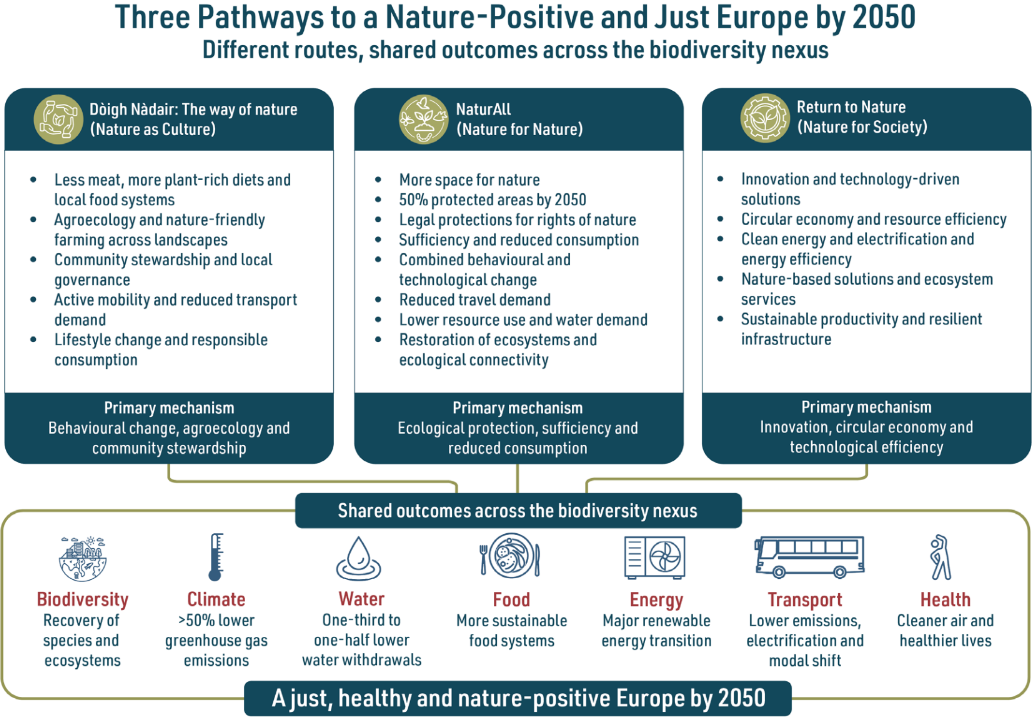
Figure 1: Three pathways towards a nature-positive and just Europe by 2050. The BIONEXT modelling demonstrates that Dòigh Nàdair (Nature as Culture), NaturAll (Nature for Nature) and Return to Nature (Nature for Society) all improve outcomes across biodiversity, climate, water, food, energy, transport and health, but through different combinations of behavioural change, governance reform, conservation measures and technological innovation.
Policy Implications and Recommendations
1. Move from sectoral policymaking to integrated nexus governance
Policies for biodiversity, climate, agriculture, water, energy, transport and public health should be designed and evaluated together. The modelling shows that the greatest benefits occur when interventions target shared drivers such as livestock demand, fossil fuel dependence, pollution and inefficient resource use. Cross-sectoral assessment and integrated planning should become standard practice.
2. Prioritise demand-side measures alongside technological solutions
Reducing demand for resource-intensive goods and services consistently delivers some of the largest sustainability gains. Dietary change, reductions in food waste, mobility sufficiency, active travel and energy conservation generate benefits for biodiversity, climate, water security and public health simultaneously. These measures should complement, rather than compete with, investments in clean technologies and infrastructure.
3. Accelerate biodiversity restoration through integrated spatial planning
Protected area expansion and ecosystem restoration are central to all pathways, but the magnitude of positive outcomes depends on where and how actions are implemented. Spatial planning should identify biodiversity hotspots, ecological corridors, climate refugia and areas suitable for renewable energy development to minimise conflicts and maximise co-benefits.
4. Support diverse pathways that reflect societal values and regional contexts
No single transformation pathway is universally optimal. Community stewardship, ecological protection and technological innovation can all contribute to nature-positive futures. Policymakers should support context-specific policy portfolios that reflect local values, institutional capacities and socio-economic conditions while maintaining shared sustainability objectives.
5. Strengthen participatory and multi-level governance
Transformative change for sustainability requires coordination across European, national and local levels and depends on public legitimacy. Citizen assemblies, stakeholder dialogues and community-led initiatives can help improve effectiveness, social acceptance and fairness.
6. Invest in long-term enabling conditions and lock in progress
Achieving nature-positive futures requires sustained investment in renewable energy systems, nature-based solutions, agroecological transitions, green skills and innovation. These investments should be supported by long-term legal and financial frameworks that secure progress beyond electoral cycles.
References
Harrison PA, Linney G, Kim H, Brown C, Cojocaru G, Díaz-General E, Ioannou A, Kasiteropoulou D, Laspidou C, Lazurko A, Raymond J & Rounsevell M (2026). Report describing the application of the nexus modelling framework. BIONEXT project deliverable D1.3 Report describing the application of the nexus modelling framework | BIONEXT
The project: BIONEXT is a research and innovation project that joins the fight for nature and biodiversity. The project produces new evidence to better understand biodiversity loss and demonstrates how biodiversity underpins every aspect of life; the water we drink, the food we eat, and our health. To secure and protect these values, the project demands transformative change: BIONEXT’s goal is a sustainable society, where links between biodiversity, water, food, energy, transport, climate, and health are acknowledged and nature and biodiversity are a part of everyday choices and policymaking.
Project coordinator: Finnish Environment Institute (Syke), (Finland)
Project partners: Dutch Research Institute for Transitions (DRIFT), (Netherlands); Global Change Research Institute of the Czech Academy of Sciences (CzechGlobe), (Czech Republic); Athina-erevnitko kentro kainotomias stis technologies tis pliroforias, ton epikoinonion kai tis gnosis (ATHENA), (Greece); Karlsruhe Institute of Technology (KIT), (Germany); Oppla, (Netherlands); Foundation for Applied Information Technology in Environment, Agriculture and Global Changes (TIAMASG), (Romania); the University of Antwerp, (Belgium); The UN Environment Programme World Conservation Monitoring Centre (UNEP-WCMC), (United Kingdom); UK Centre for Ecology & Hydrology (UKCEH), (United Kingdom)

Bionext Policy Brief | 9 | 2026
Delivering a Nature-Positive Europe: Insights from Biodiversity Nexus Modelling
Authors: Paula Harrison1) ,George Linney1), HyeJin Kim1), Calum Brown2), George Cojocaru3), Elizabeth Díaz-General2), Alexandra Ioannou4), Dorothea Kasiteropoulou4), Chrysi Laspidou4), Anita Lazurko1), Joanna Raymond2), Mark Rounsevell2)
1) UK Centre for Ecology & Hydrology, (UKCEH), 2) Karlsruher Institut für Technologie (KIT), 3) Foundation for Applied Information Technology in Environment, Agriculture and Global Change (TIAMASG), 4) Research & Innovation Information Technologies (ATHENA)
Layout and infographics: Finnish Environment Institute (Syke)
Photo: Stock.adobe.com
Publisher: Finnish Environment Institute (Syke)
Helsinki 2026
ISBN 978-952-11-5884-1 (PDF)
DOI (Helda): 10.58013/s6pt-a521