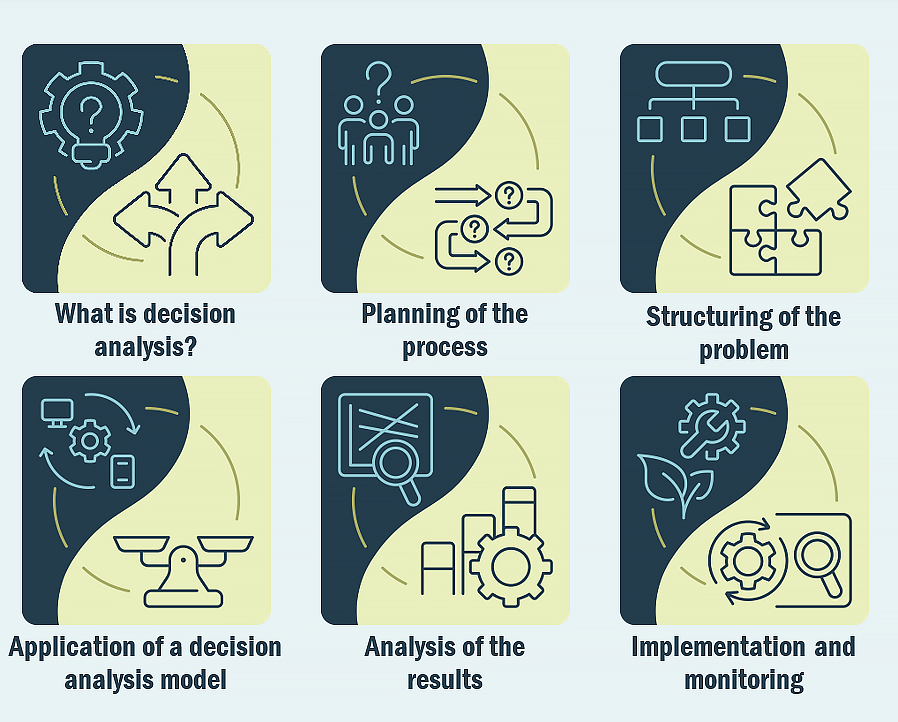
Policy Brief | Supporting environmental decision making through responsible AI-assisted Decision Analysis (AIDA)
Introduction
Environmental decision makers increasingly face complex challenges that require balancing environmental, social, and economic objectives across multiple stakeholders and temporal scales. To address these challenges, decision analysis provides a transparent and systematic framework for evaluating policy or management actions based on their impacts across different criteria and stakeholder preferences regarding those criteria. Such evidence-informed decision making is particularly important in biodiversity conservation and restoration, where ecological complexity, uncertainty, and competing stakeholder interests often create difficult trade-offs.
At the same time, advances in generative artificial intelligence (AI) have created new opportunities to enhance decision making processes by supporting information synthesis, learning, communication, and analytical tasks. Realising these benefits responsibly requires using AI in a way that strengthens rather than undermines transparency, participation, accountability, and trust.
In response, the BIONEXT project has developed the AIDA (AI-assisted Decision Analysis) tool that provides practical guidance on the responsible use of generative AI throughout the decision analysis process. AIDA complements the Ask BIONEXT App, an AI research assistant for exploring and synthesising knowledge and evidence produced by the BIONEXT project.
Principles for responsible use of AI in decision analysis
Despite the opportunities of generative AI, it should be understood as a support tool rather than a source of authoritative answers. Responsible use requires awareness of its limitations, critical evaluation of its outputs, and transparency about how AI has been rigorously used in the process. The key principles for responsible use of AI in decision analysis are:
Accountability
Human responsibility for decisions cannot be delegated to AI.
Decision makers remain accountable for outcomes.
Participation
AI should support, not replace, stakeholder engagement and deliberation.
Stakeholder values and preferences should be expressed by stakeholders themselves.
Sensitive information should not be shared with unauthorized AI systems.
Transparency
Stakeholders should know when AI has been used.
AI-supported analyses should be documented and, where possible, reproducible.
Reliability
AI outputs should be treated as hypotheses rather than facts.
Important claims must be verified using credible sources and critically reviewed by human experts.
Benefits and risks of using generative AI to support decision analysis
Generative AI can strengthen many phases of a decision analysis process, from problem framing and information gathering to communication of results. However, the magnitude of the benefits depends on how AI is used and whether appropriate safeguards are followed. Responsible implementation requires balancing the opportunities offered by AI with awareness of technical, process-related, and governance-related risks.
Major benefits of using AI
Faster synthesis of large volumes of information
Support for learning and capacity building
Generation of suggestions for alternative framings and solutions
Procedural support for structured analysis and deliberation
Increased awareness of various methods
Enhanced communication among stakeholders
Major risks of using AI
Technical : hallucinated facts; computational errors; misinterpretation of methods
Process-related: reduced stakeholder engagement; overreliance on AI outputs; weakened ownership of decisions
Governance-related: biased framing of problem, alternatives or evidence; unclear accountability and value judgements; hidden assumptions and value judgements; insufficient transparency of AI use
Applicability of AI in different tasks of the decision analysis process
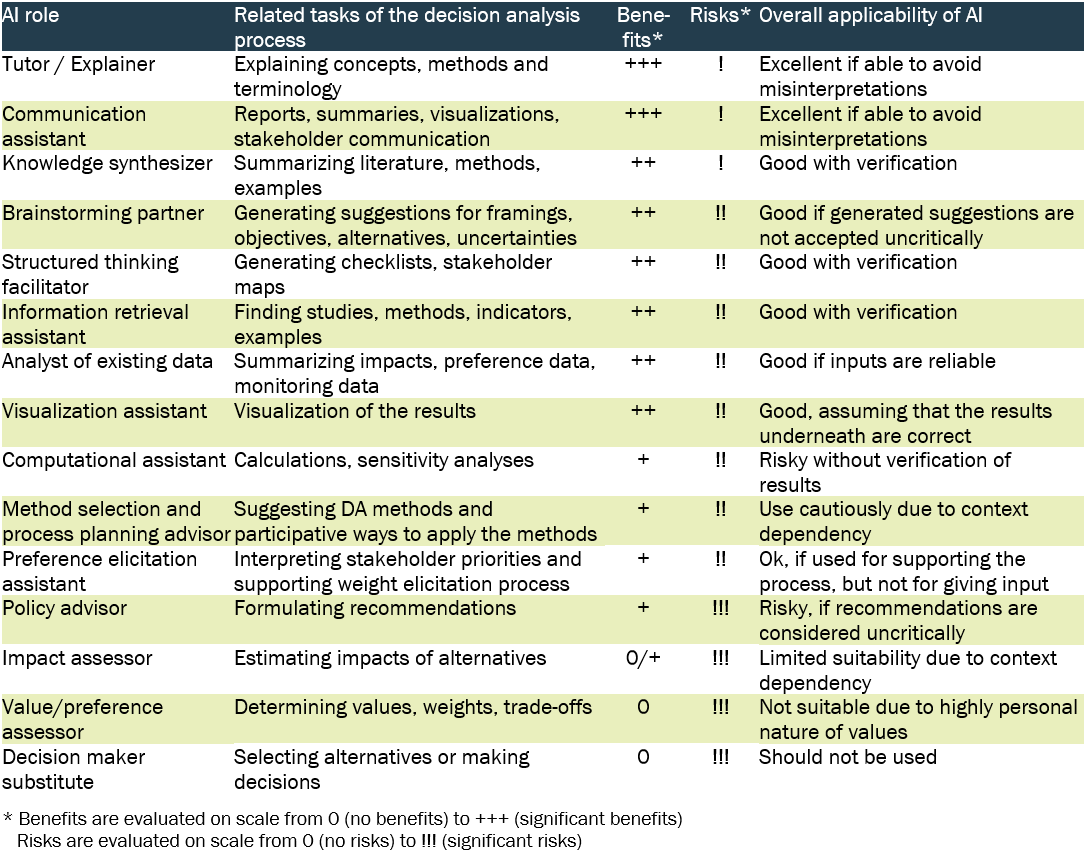
The benefits and risks of using AI vary according to both the role assigned to AI and the specific decision analysis task being performed. Overall, AI is most useful for learning, communication, information synthesis, and structured thinking, while its suitability decreases substantially in tasks involving values, impact judgements, or final decisions. Table 1 summarises the support provided by the AIDA tool about the benefits and risks of applying AI in different tasks of the decision analysis process.
Table 1. The benefits and risks of applying AI in different tasks of the decision analysis process.
AIDA and Ask BIONEXT
AIDA works alongside the Ask BIONEXT App, an AI research assistant developed by BIONEXT to make project knowledge and evidence easier to find, understand and use. Users can ask questions in ordinary language and receive answers based on a carefully selected collection of BIONEXT research and other approved evidence, with citations and links to the original sources.
The two tools have complementary roles: Ask BIONEXT helps users find and synthesise relevant evidence, while AIDA provides guidance on how generative AI can be used responsibly within a structured decision analysis process. Together, they provide a practical framework for integrating generative AI into structured environmental decision analysis and demonstrate how AI can support access to evidence and informed decision making while retaining transparency, verification and human judgement.
Policy recommendations
Responsible AI is not about replacing decision makers; it is about strengthening human judgement, transparency, and stakeholder engagement to enable better-informed decisions for transformative change. Key recommendations for the responsible use of AI to support decision analysis process are:
Ensure that AI is used to support, rather than replace, human judgement and decision making.
Require transparency regarding AI use in decision support processes.
Ensure independent verification of important AI-generated information.
Safeguard meaningful stakeholder participation throughout decision processes.
Provide practitioners with training and guidance tools, such as AIDA, to support responsible AI use.
Use AI tools that provide transparent links to trusted evidence and verifiable sources.
Document how AI has been used in decision analysis processes, including key prompts, assumptions, and verification steps.
Links
Ask BIONEXT App: https://tinyurl.com/BIONEXT-App
AIDA (AI-assisted Decision Analysis): https://oppla.eu/bionext/decision-analysis-environmental-decision-making
The project: BIONEXT is a research and innovation project that joins the fight for nature and biodiversity. The project produces new evidence to better understand biodiversity loss and demonstrates how biodiversity underpins every aspect of life; the water we drink, the food we eat, and our health. To secure and protect these values, the project demands transformative change: BIONEXT’s goal is a sustainable society, where links between biodiversity, water, food, energy, transport, climate, and health are acknowledged and nature and biodiversity are a part of everyday choices and policymaking.
Project coordinator: Finnish Environment Institute (Syke), (Finland)
Project partners: Dutch Research Institute for Transitions (DRIFT), (Netherlands); Global Change Research Institute of the Czech Academy of Sciences (CzechGlobe), (Czech Republic); Athina-erevnitko kentro kainotomias stis technologies tis pliroforias, ton epikoinonion kai tis gnosis (ATHENA), (Greece); Karlsruhe Institute of Technology (KIT), (Germany); Oppla, (Netherlands); Foundation for Applied Information Technology in Environment, Agriculture and Global Changes (TIAMASG), (Romania); the University of Antwerp, (Belgium); The UN Environment Programme World Conservation Monitoring Centre (UNEP-WCMC), (United Kingdom); UK Centre for Ecology & Hydrology (UKCEH), (United Kingdom)

Bionext Policy Brief | 7 | 2026
Supporting environmental decision making through responsible AI-assisted Decision Analysis (AIDA)
Authors: Jyri Mustajoki 1), George Cojocaru 2), Hans Keune 3), Paul Mahony 4), Jonathan Porter 4)
1) Finnish Environment Institute (Syke), 2) Foundation for Applied Information Technology in Environment, Agriculture and Global Change (TIAMASG), 3) University of Antwerp, 4) Oppla
Layout and infographics: Finnish Environment Institute (Syke), Oppla
Photo: stock.adobe.com
Publisher: Finnish Environment Institute (Syke)
Helsinki 2026
DOI (Helda): 10.58013/y66y-kj61
Key messages
Responsible use of generative AI in decision analysis requires transparency, validation of outputs, human oversight, accountability, and meaningful stakeholder engagement.
The benefits, risks, and appropriateness of AI vary substantially across the various phases and tasks of the decision analysis process.
Generative AI offers the greatest potential for supporting decision analysis through information processing, knowledge synthesis and exploration, learning, and communication.
Generative AI is not suitable for determining stakeholder values, resolving value conflicts, or making decisions; it can support, but never replace, human judgement and stakeholder deliberation.
The AIDA tool provides practical guidance for applying generative AI in a transparent, accountable, and trustworthy manner throughout the decision analysis process.
AIDA tool
Like the protagonists of Verdi's Aida, decision makers often face difficult choices involving competing objectives, stakeholder interests, uncertainties, and values. Decision analysis helps make these tensions explicit, supports the systematic exploration of alternatives, and enhances transparency in decision making. The AIDA tool provides guidance and prompting questions to enhance responsible and effective use of generative AI throughout the decision analysis process. AIDA was developed through experiences and lessons learned within the BIONEXT project and reflects broader literature on responsible AI and decision support.