

Policy Brief | Interlinkages between biodiversity, climate, food, water, energy, transport and health: A concentrated dose for policymakers
Biodiversity underpins every aspect of life on Earth – from the water we drink and the food we eat to the air we breathe and the health of people and ecosystems. Yet it is being degraded and lost at an unprecedented rate. To halt or reverse this decline, we must understand how biodiversity supports systems such as food production and consumption, water quality and availability, climate regulation and mitigation, human and ecosystem health, energy production, and transportation.
Clarifying underlying mechanisms for the influence of biodiversity on other nexus elements (or ‘sectors’), including climate, food, water, energy, transport, and health, provides essential evidence for coherent policies. This evidence that informs us on how human and natural systems are intertwined needs to be accessible and usable in decision-making processes. Only then can we design and implement holistic and coherent policies and actions across sectors and societies.
To help this understanding, we conducted a literature review on the interlinkages between biodiversity and climate change, food, water, energy, transport and health (“the biodiversity nexus”). Evidence extracted from 194 peer-reviewed articles was analysed to assess how biodiversity is being influenced by and is influencing the other nexus elements.
The biodiversity nexus demonstrates the diverse, intertwined relationships between people and nature. It shows how our resource use affects nature and biodiversity and vice versa.
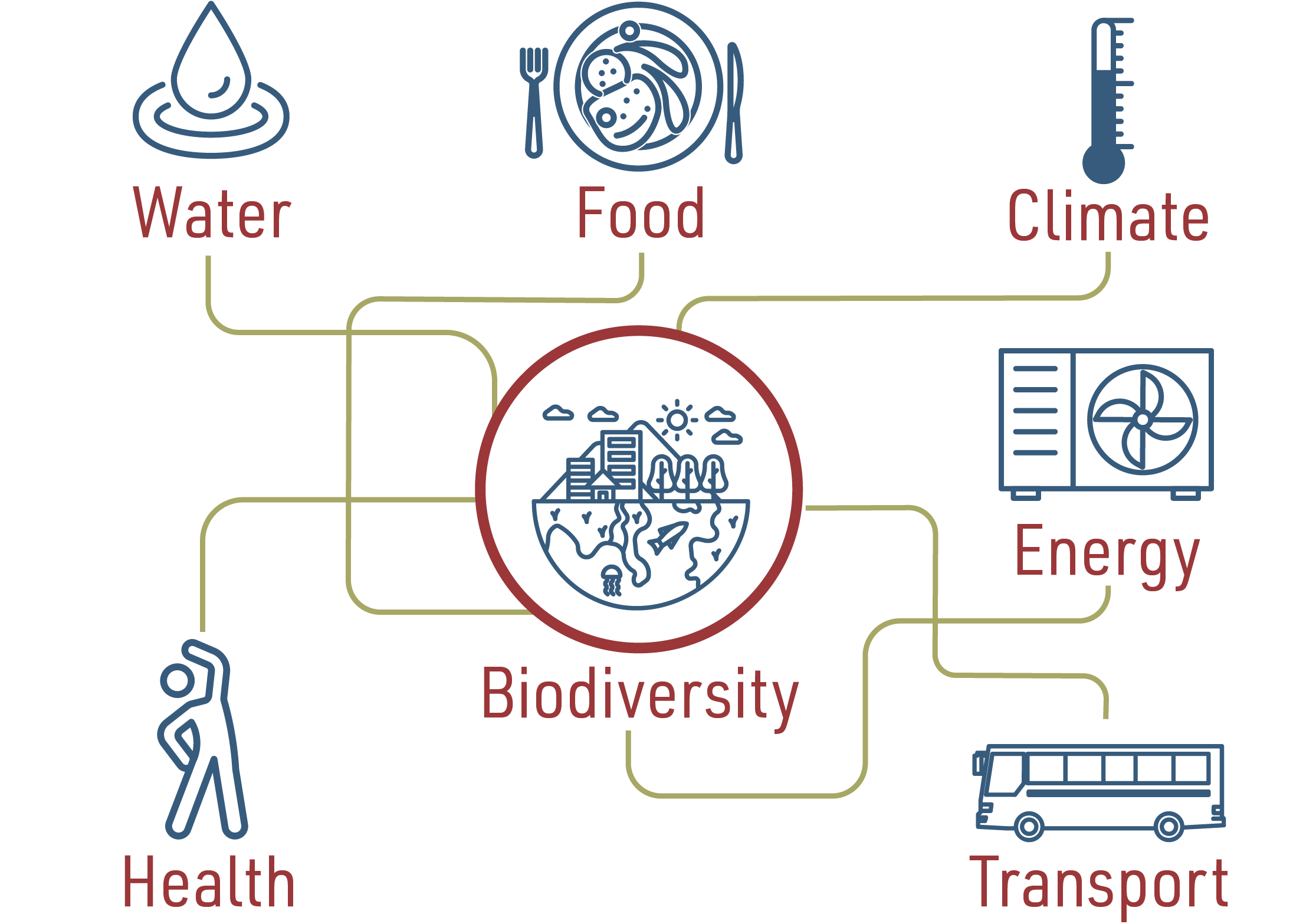
The biodiversity nexus demonstrates the diverse, intertwined relationships between people and nature. It shows how our resource use affects nature and biodiversity and vice versa.
Key findings
From this analysis we found that evidence exists on how biodiversity is influencing and is influenced by other nexus elements when using a broader definition of biodiversity spanning across organismal levels and dimensions
A major portion of studies highlighted the substantial damage being inflicted on nature by human activities (so-called “trade-offs”, which include):
Land use/land use alteration: habitat destruction for expansion of food production, competition for land from land-based renewable energy (bioenergy, solar, wind), habitat fragmentation from transport and energy infrastructure
Water use/water course alteration: alteration of water flows and river fragmentation due to dams and reservoirs related to hydropower, water demand for energy and irrigation reducing environmental flows, and dredging affecting coastal and marine ecosystems
Land degradation: agricultural intensification affecting habitat quality and species diversity and richness, peat extraction for energy, and mining for renewable energy
Water degradation: eutrophication, acidification, brownification and sedimentation affecting freshwater, coastal and marine ecosystems and species
Climate change: heat or water stress, seasonality and floods impacting species and ecosystems
Direct species fatalities: wind turbines and traffic (road, rail, shipping) causing direct collisions
However, there are policies and management actions that can bring multiple benefits (so called “co-benefits” or “synergies”) between biodiversity and other nexus elements, which include:
Biodiversity-friendly management: agro-biodiversity or agroecological practices, sustainable management of bioenergy cropping systems, integrated management of water landscapes, and management of habitats on road verges and railway embankments
Restoration of ecosystems: forests and peatlands for climate mitigation and biomass energy production, riparian forests for flood control, and remediation of water courses for improving water quality.
Protection of species and ecosystems: that are key in maintaining and enhancing ecosystem services such as water filtration and water retention.
Urban green and blue infrastructure: green roofs for improving energy performance in buildings, greening of transport infrastructure for pollution control through promotion of active transport (walking, cycling), urban green space for health benefits.
Dietary change: moving to healthier and more sustainable diets, including reducing the consumption of meat to reduce livestock for climate mitigation.
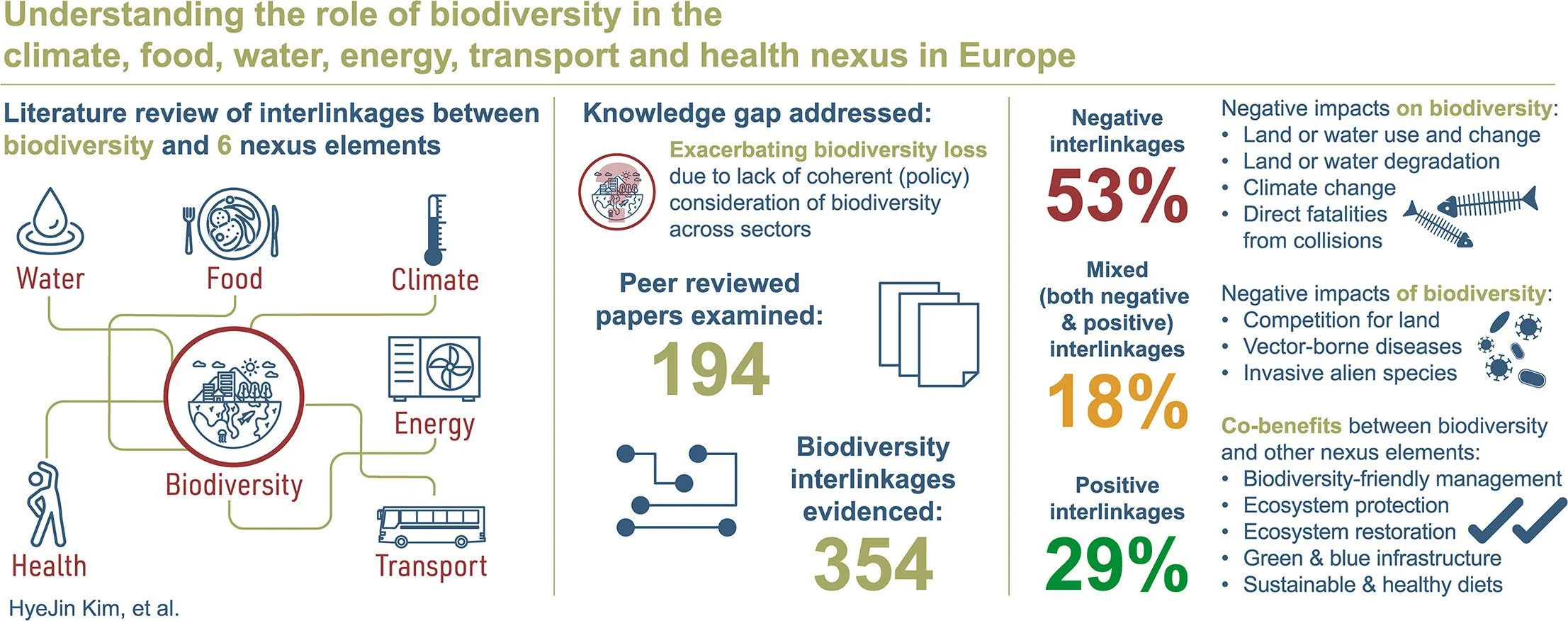
Key findings summarized on what was studied, evidenced and found from this review (Kim et al. 2024).
The review (Kim et al. 2024) gave valuable insight into the impact of human activities on biodiversity through the climate, water, food, energy, transport and health elements. Alternatively, there was limited evidence on how biodiversity could negatively impact other nexus elements, which included competition for land, disease transmission from a small set of species triggered by habitat gain or loss and climate change, and the introduction and expansion of invasive alien species.
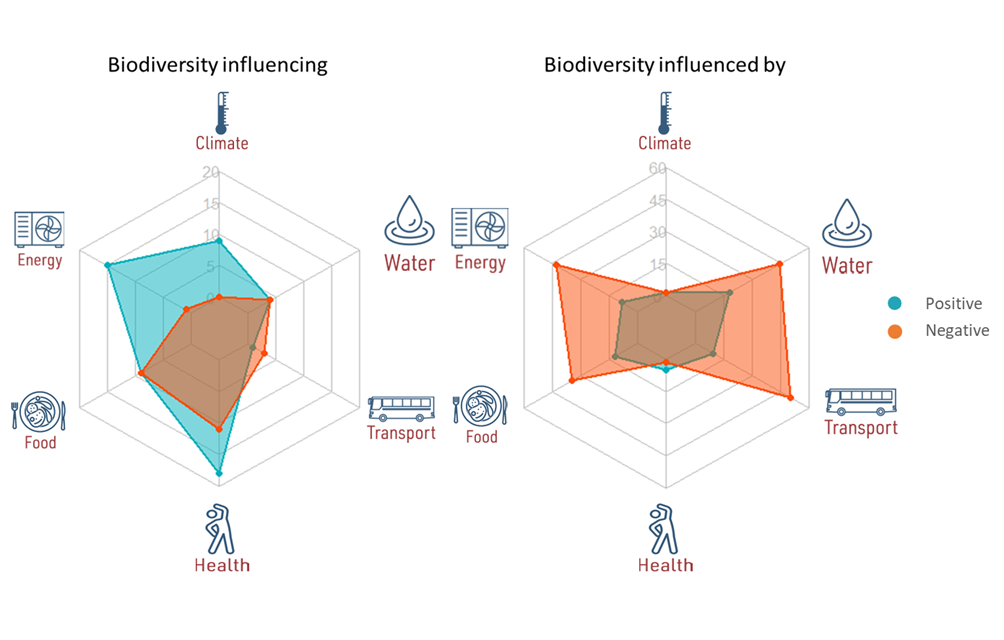
Biodiversity’s impact on the nexus elements and vice versa based on the counts of positive or negative interlinkages in the 192 studies reviewed in database
Our message to policymakers
Appropriate holistic interventions and actions require evidence from both academic nexus studies as well as from practical experiences for the proper design, planning and implementation of policies. Here are the key recommendations on how the evidence base can be improved:
Information on the biodiversity nexus needs to be used in decision-making processes. This review reveals that rich information on the biodiversity nexus indeed exists in the literature and practice. It is essential that this information is made accessible and synthesized to inform decision processes
Further research is needed on quantifying positive impact relationships in the biodiversity nexus. There is currently far more studies on negative impact than positive impact in the literature. To inform the implementation of synergistic actions that bring co-benefits across sectors through biodiversity, it is critical to fill this research gap.
Reviews such as this one can be replicated in other world regions. The replications will help us to better understand regional, environmental, economic and socio-political similarities and differences in the biodiversity nexus and identify approaches that minimize trade-offs and maximize co-benefits across the regions.
References:
Kim, HyeJin, Lazurko, Anita, Linney, George, Maskell, Lindsay, Díaz-General, Elizabeth, Jungwirth Březovská, Romana, Keune, Hans, Laspidou, Chrysi, Malinen, Henna, Oinonen, Soile, Raymond, Joanna, Rounsevell, Mark, Vaňo, Simeon, Demaria Venâncio, Marina, Viesca-Ramirez, Alejandrina, Wijesekera, Ayesha, Wilson, Katie, Ziliaskopoulos, Konstantinos, Harrison, Paula A. (2024). Understanding the role of biodiversity in the climate, food, water, energy, transport and health nexus in Europe.https://doi.org/10.1016/j.scitotenv.2024.171692
Further materials:
The project: BIONEXT is a research and innovation project that joins the fight for nature and biodiversity. The project produces new evidence to better understand biodiversity loss and demonstrates how biodiversity underpins every aspect of life; the water we drink, the food we eat, and our health. To secure and protect these values, the project demands transformative change: BIONEXT’s goal is a sustainable society, where links between biodiversity, water, food, energy, transport, climate, and health are acknowledged and nature and biodiversity are a part of everyday choices and policymaking.
Project coordinator: Finnish Environment Institute (Syke), (Finland)
Project partners: Dutch Research Institute for Transitions (DRIFT), (Netherlands); Global Change Research Institute of the Czech Academy of Sciences (CzechGlobe), (Czech Republic); Athina-erevnitko kentro kainotomias stis technologies tis pliroforias, ton epikoinonion kai tis gnosis (ATHENA), (Greece); Karlsruhe Institute of Technology (KIT), (Germany); Oppla, (Netherlands); Foundation for Applied Information Technology in Environment, Agriculture and Global Changes (TIAMASG), (Romania); the University of Antwerp, (Belgium); The UN Environment Programme World Conservation Monitoring Centre (UNEP-WCMC), (United Kingdom); UK Centre for Ecology & Hydrology (UKCEH), (United Kingdom)

Bionext Policy Brief | 3 I 2026
Interlinkages between biodiversity, climate, food, water, energy, transport and health: A concentrated dose for policymakers
Authors: Kim, H. 1), Kulmala, S. .2), Airos, M. 2)
1) UK Centre for Ecology & Hydrology , 2) Finnish Environment Institute (Syke)
Layout and infographics: Finnish Environment Institute (Syke)
Photos: stock.adobe.com
Publisher: Finnish Environment Institute (Syke)
Helsinki 2026
ISBN 978-952-11-5880-3 (PDF)
DOI (Helda): 10.58013/qbpx-xv6